Kratos : Building A Modern Defense Business
When Eric DeMarco joined Wireless Facilities in 2003, the plan was straightforward: diversify a commercial telecom infrastructure company into the defense sector. What followed was anything but. Within a few years, consolidation in the wireless industry had compressed gross margins from 50% to 5%, forcing the board into a more radical decision. They sold the commercial business entirely, including the name, and on January 1st, 2008, Kratos Defense & Security Solutions was born. "No business. Some cash from the sales," DeMarco recalls. "And we put together a strategy to build a military hardware company."
Few founding moments could have been less auspicious. The global financial crisis was breaking, defense budgets were heading into a decade of contraction under sequestration, and Kratos had no revenue. Today, with more than 5,200 employees across 13 countries, annual revenues growing sharply, and programs spanning unmanned combat aircraft, hypersonic systems, jet engines, and space and satellite telemetry, command and control systems, the company DeMarco built from scratch has become one of the most closely watched names in American defense. And the tailwinds at its back have never been stronger.
THE AFFORDABILITY DOCTRINE
"The cost paradox has completely changed," DeMarco says. "Quantity has a quality all of its own."
To understand Kratos, you have to understand its founding philosophy, what DeMarco calls a "Kratosism": affordability as a technology, not an afterthought.
"Quantity matters, not just quality," DeMarco says, citing not only current threat assessments but his own reading of history. "The Germans had the most exquisite weapons in World War II, the first cruise missile, the first ballistic missile, but they couldn't build enough of them. They were overwhelmed by quantity." The lesson he draws is unambiguous: in a high-intensity conflict against a peer adversary, the ability to mass-produce capable systems at low cost is a strategic advantage in itself.
Recent conflicts have validated the thesis in real time. The war in Ukraine has consumed drones by the tens of thousands each month. In the Middle East, sophisticated and expensive interceptors have been deployed against comparatively cheap attack drones, raising serious questions about the long-term cost calculus of air defense. "The cost paradox has completely changed," DeMarco says. "Quantity has a quality all of its own."

PRODUCTS, NOT POWERPOINTS
Alongside affordability, DeMarco has built Kratos around a second principle: fielding real hardware ahead of demand rather than chasing contracts with concept-stage presentations. He summarizes it as "products, not PowerPoints."
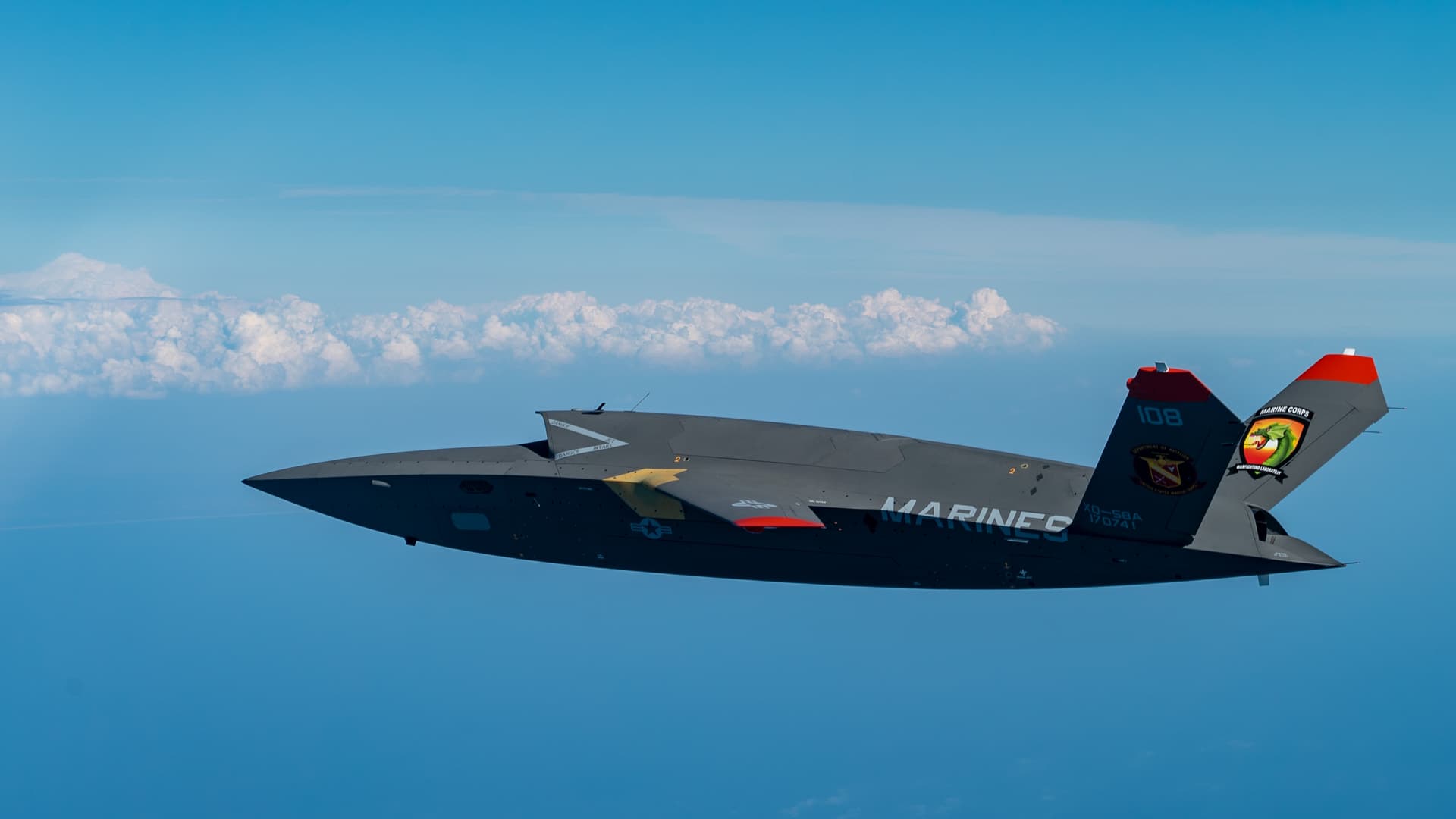
The approach has produced several notable firsts. The Kratos Valkyrie, a stealthy, long-range unmanned combat air vehicle, has been flying since 2019, accumulating test hours with multiple branches of the Department of Defense, deploying weapons, operating with electronic warfare systems, and demonstrating interoperability with manned fighters. Earlier this year, the U.S. Marine Corps selected the Valkyrie as its collaborative combat aircraft (CCA) program of record, a validation DeMarco describes as confirmation of the right product, right time, right price point. "It's a $10 to $15 million missionized aircraft that can go 3,000 miles unrefueled," he says. "That's an incredible stamp of credibility."
The Valkyrie is far from the only example. Kratos was first to market with a hypersonic glide vehicle test platform, first with a family of affordable jet engines for small cruise missiles and drones, and now first in line as the Pentagon accelerates procurement in both areas. The Secretary of Defense's now-famous "Arsenal of Freedom" speech last year, calling for "85% of the solution right now that works" rather than "100% someday at some price that may or may not work," might as well have been written about Kratos.
THE INFLECTION POINT
Defense budgets tell part of the story starkly. In 2015, at the depth of sequestration, the base defense budget sat at $485 billion. Last year it reached $800 billion. The 2026 request stands at over a trillion dollars. DeMarco draws an explicit historical parallel: "I analogize this to the Reagan buildup in the eighties, which started in 1980 and really didn't end until 1990. I think we are in the first inning of a nine-inning game."
More for you
His confidence is rooted in something more durable than any single administration's priorities. The geopolitical threat environment, a nuclear-armed Russia actively waging war in Europe and a rapidly modernizing China, has fundamentally reoriented U.S. defense planning toward the kind of strategic, high-end systems that Kratos has spent nearly two decades developing. "For two or three decades after Reagan, we fought terrorists. Strategic weapon systems weren't involved. Well, that entire paradigm has shifted."
The financial results are beginning to reflect it. Kratos's hypersonic franchise, a segment believes the market still underestimates, generated roughly $200 million in revenue in fiscal 2025. He projects $400 million this year, and more than $700 million the year after. The jet engine business, currently transitioning into low-rate initial production ahead of full-rate manufacturing, could eventually see tens of thousands of units annually across multiple programs. "Then people are going to realize they didn't appreciate the significance of this," DeMarco says.
BUILDING THE INDUSTRIAL BASE
Kratos's expansion is physical as well as financial. The company has been growing its manufacturing footprint, with a new hypersonic payload integration facility coming online in Indiana and additional capacity in Alabama, at a moment when national security industrial capability has become a national security conversation in its own right. DeMarco is emphatic that pessimism about U.S. manufacturing is misplaced. "It's called prioritization and focus," he says. "This country right now, at the executive branch, the congressional branch, and in the Department, is focused on rebuilding the defense industrial base and they are putting their money where their mouth is."
He is more circumspect about technology trends than some peers. On 3D printing and AI, his view is characteristically pragmatic: useful tools in the right context, but not panaceas. "If you're going to do a production run of a thousand cruise missile engines, 3D printing doesn't work. The old milling, casting, and forging is the most cost-effective way to maintain tolerances." He sees real short-term benefits alongside longer-term questions about what it means for human judgment and institutional knowledge. "We have to be smart. Reinventing the wheel comes with cost and inefficiency."
CULTURE AT SCALE
Managing more than 5,000 people across a highly decentralized organization without losing speed is, DeMarco acknowledges, one of the harder problems in defense business. His answer has been structural: six autonomous divisions, each led by a long-tenured president with deep domain expertise, full P&L responsibility, and their own business development function, all threading together under a shared strategy. "You cannot be the best at everything, so you better pick a few things and be number one or two at them."
Crucially, none of his division presidents came from the traditional prime contractors, not because those organizations lack talent, but because their cultures are fundamentally different from Kratos's own entrepreneurial speed. "At Kratos, if there are ten decisions to make, we make ten decisions. Eight are good, two aren't. But at least we made ten decisions and didn't miss an opportunity waiting for fifteen committees."
In an industry where the pace of threat evolution increasingly outstrips the pace of procurement, that instinct for speed may be Kratos's most durable competitive advantage.