Ducommun's VISION 2032: Building the Next Chapter of an American Industrial Legacy
Some companies measure their history in decades. Ducommun measures its own in centuries. Founded in 1849, the company is the oldest company in California still active today, having evolved from a Gold Rush-era store selling picks and axes into a sophisticated aerospace and defense manufacturer. Today, Ducommun provides engineered products and aftermarket solutions along with electronic and structural manufacturing services to some of the most demanding customers in commercial aerospace, defense and space.
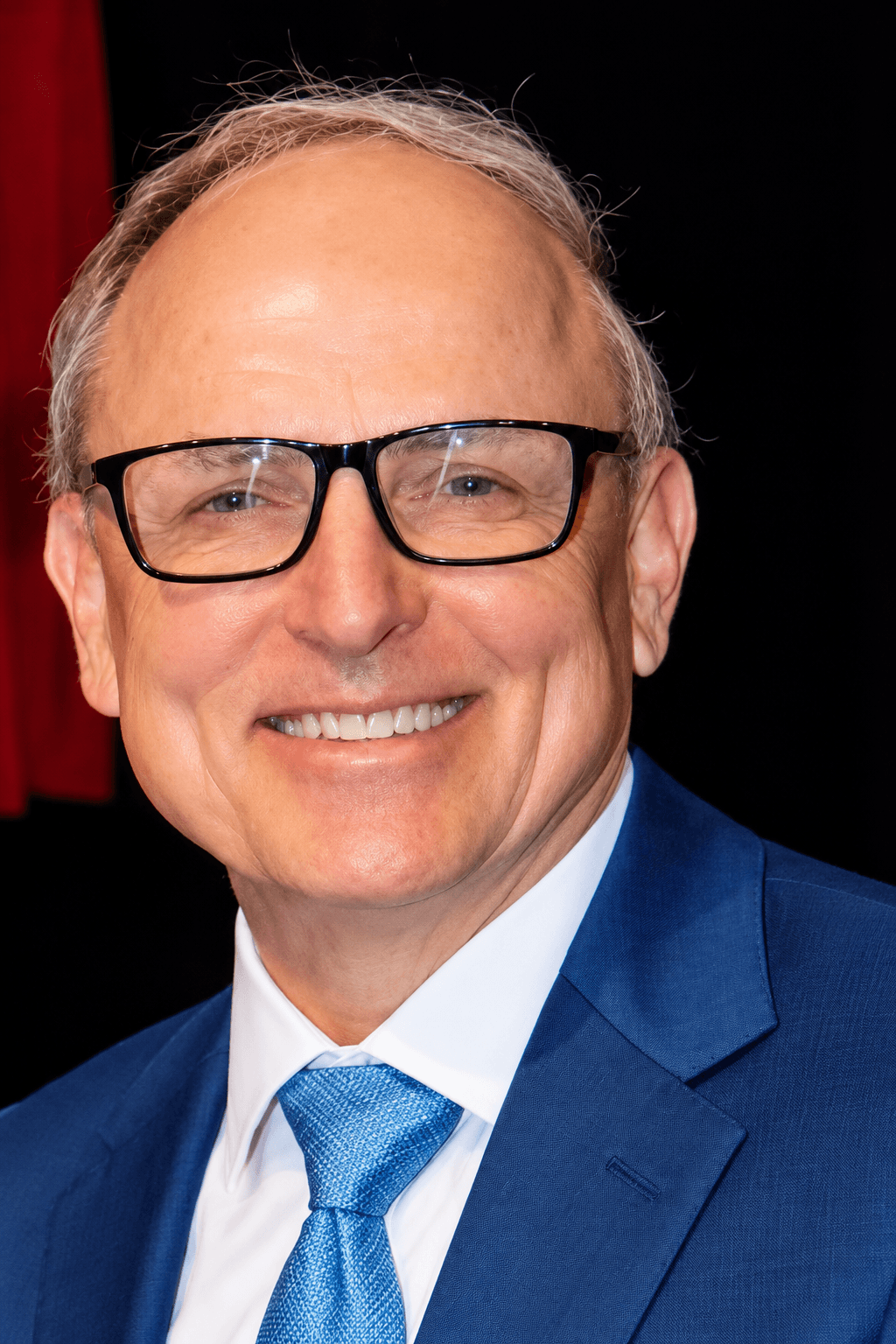
At the center of its latest transformation is Stephen G. Oswald, Chairman, President and Chief Executive Officer - whose career has been built around leadership, operations, revenue growth and turning businesses into stronger versions of themselves.
Oswald joined Ducommun (NYSE: DCO) in 2017 after a career in both large cap and private equity including General Electric, United Technologies (now RTX), KKR, where he led portfolio company Capital Safety, and Hoechst Celanese. But his ambition for Ducommun has never been limited to turning around a company that had struggled in the years before his arrival. His larger objective has been to build a different kind of aerospace and defense company, help move the industry forward and create meaningful value.
““When people look back on my leadership, I hope one thing rises above the rest: that overall, everybody won.” - Stephen G. Oswald”
The latest phase of this ambition has a name: VISION 2032.
From Operations to the Corner Office
Oswald began his career at General Electric in 1986, initially working in supply chain before moving through operations, manufacturing, supervision and technical sales across several GE businesses, including lighting, aircraft engines and plastics.
He later joined United Technologies, after earning an MBA through the University of Chicago’s Executive MBA program. At United Technologies he held a series of increasingly senior leadership roles. In 2002, at the age of 37, he became president of Sullair Inc. taking responsibility for a full global P&L for the first time.
His career subsequently took him through numerous leadership assignments, including President of Hamilton Sundstrand’s Industrial division before he joined KKR in 2012 as an operating executive. There, he became CEO of Capital Safety, leading the transformation of the company to a global safety supplier and then through its sale to 3M in 2015.
After taking some time off, Oswald turned his attention to Ducommun.
He arrived at a company that had endured several difficult years. But he believed the problems were largely behind it - and that the underlying opportunity was much greater.
“I am effective as a turnaround person, but I’m really a growth leader,” he says.
His philosophy has remained consistent: “You can never cut your way to success.”
Cost discipline matters, but Oswald believes sustainable growth comes from building a customer-focused organization, developing the right culture, improving operations and earning the right to charge customers appropriately for the value the company creates.
His shorthand for that idea is unusually simple.
“When people look back on my leadership, I hope one thing rises above the rest: that overall, everybody won.”
An American Industrial Legacy
For Oswald, the opportunity at Ducommun was about more than turning around an underperforming aerospace supplier. He was also taking charge of a company whose history reaches back to the Gold Rush and which was founded the year before California became a state. The company also holds an important place in the development of American aviation that few industrial companies can match.
Frenchman Charles Ducommun, who was raised in Switzerland, moved to the United States in 1843 and made his way to California after the Mexican-American War. A trained watchmaker, he opened a store to serve miners and his shop eventually became an industrial enterprise whose fortunes became intertwined with the emergence of Southern California’s aviation industry.
Ducommun supported and supplied tooling, raw materials and other products to the growing aerospace sector starting in the 1920s. Its history includes connections to figures such as Donald Douglas and Alan and Malcolm Lockheed, while the company also supplied tubular steel for the Spirit of St. Louis, which was built in San Diego. The aircraft flown by Charles Lindbergh on the historic transatlantic flight over the Atlantic took off from Roosevelt Field, Long Island, NY, six miles from where Steve grew up.
The history above illustrates a recurring theme in Ducommun’s history: the company has repeatedly positioned itself alongside emerging technologies and critical American industries.
That heritage provides an important backdrop to Oswald’s modern strategy. The challenge is not simply to preserve a historic aerospace company, but to ensure that Ducommun remains relevant to the next generation of American aerospace and defense.
From Turnaround in 2017 to Transformation Today
The first stage was organizational.
Oswald flattened an organization he felt had accumulated too many layers and leadership positions. The structural change was accompanied by a cultural one: Ducommun needed to become more accountable, more selective about the business it pursued, and better at getting paid for the value it provided to customers.
The transformation was tested almost immediately. The Boeing 737 MAX crisis of 2019 hit just as the company was having one of its best years in its long history while COVID-19 in 2020, subsequently brought commercial aircraft production close to a standstill. The MAX had been Ducommun’s largest program in 2019 reaching over $100 million in revenue; the following year, production effectively collapsed.
Fortunately, the Defense business provided an important counterbalance along with M&A. The company strengthened delivery and quality performance, improved pricing and began acquiring businesses that could give Ducommun more proprietary technology and aftermarket exposure, which meant higher margins. Five engineered-product and aftermarket acquisitions have been completed since Oswald arrived.
After the MAX crisis and Covid, Oswald mapped out the next phase for growth and excellence for the company, which was formalized in VISION 2027 and presented in December 2022 at the company’s investor day.
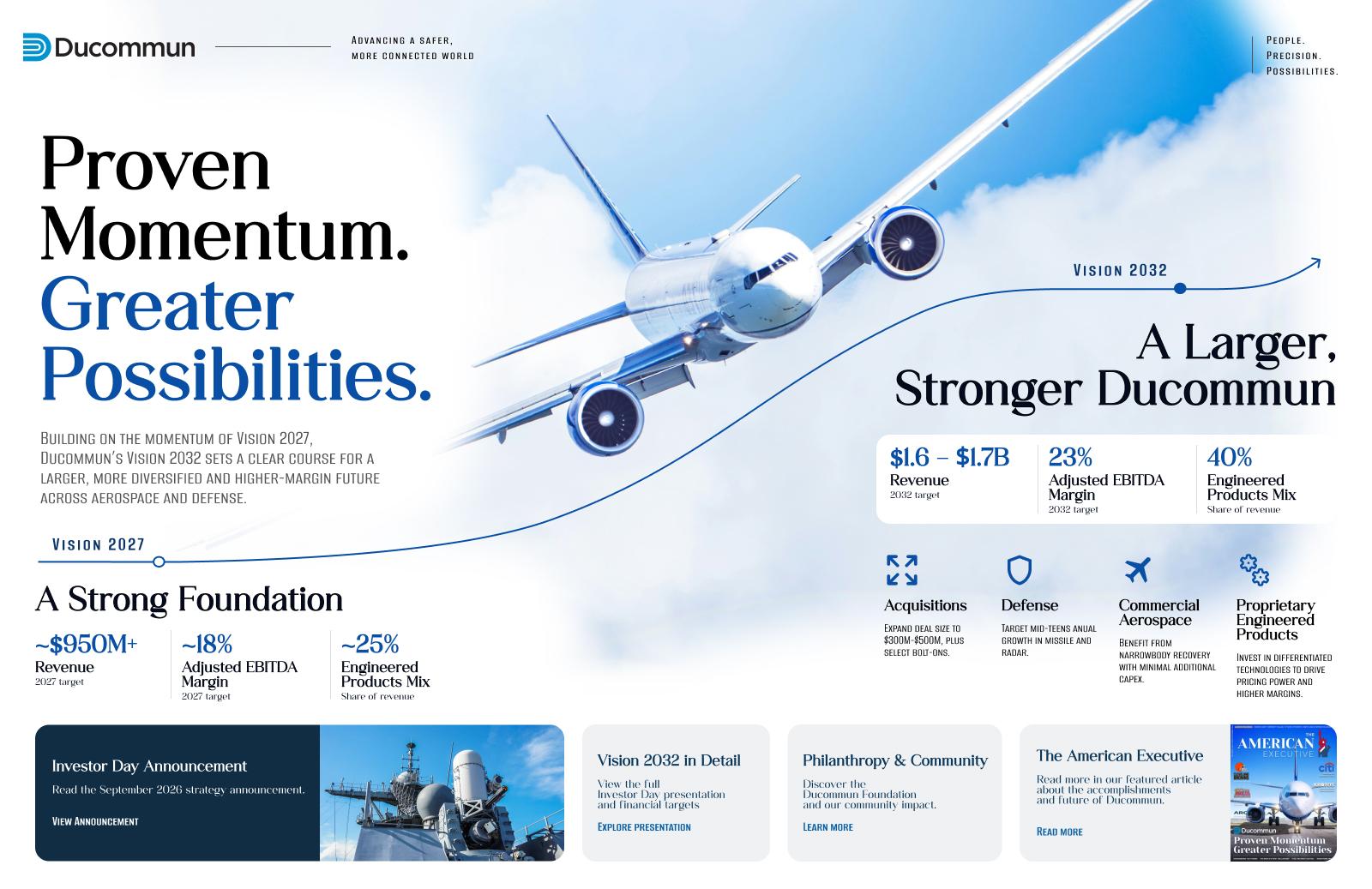
The vision targeted approximately $950 million to $1 billion in revenue from more than $700 million, an adjusted EBITDA margin of 18%, up from 13%, and engineered products and aftermarket solutions at roughly 25% of revenue, up from 15%. By the end of Q3 of 2026, Ducommun is on track to meet all three commitments by the end of next year, a significant achievement.
The foundation was now in place for something more ambitious.
The Investor View
When Oswald joined Ducommun in 2017, the company had a market capitalization of approximately $286 million. By the third quarter of 2026, that figure had risen to around $2.6 billion, representing growth of more than 800%.
Shareholders have seen strong returns across all investment periods. With Ducommun’s share price at $175.39 in early October 2026, the stock had gained 87.8% over the previous year, 303.1% over three years, and 241.7% over five years.
Ducommun’s shareholder base is dominated by major institutional investors. BlackRock is the company’s largest shareholder, with approximately 9.3%, followed by State Street at 6.3%, Paradigm Capital at 5.1%, Vanguard at 4.2% and Fidelity at 3.7%. Collectively, institutional investors own around half of the company’s outstanding shares.
Research coverage from prominent financial institutions such as Goldman Sachs and Citibank raises Ducommun’s profile among a broader range of institutional investors. With analyst price targets ranging from $180 to $246, this coverage may further strengthen investor confidence, reinforce the company’s institutional shareholder base, and support its ability to finance the acquisitions central to its VISION 2032 strategy.
VISION 2032: Oswald’s Bigger Bet
When Oswald returned to investors in New York in September for Ducommun’s 2026 Investor Day, nearly four years had passed since the company’s previous major strategy presentation. This time, he was not simply updating shareholders on VISION 2027. He was unveiling his own longer-term blueprint for the company.
VISION 2032 is designed to significantly increase Ducommun’s business, targeting approximately $1.7 billion in revenue by 2032. The strategy combines organic growth, margin expansion and acquisitions, with DCO looking to move from being primarily a manufacturing partner to a company with a portfolio increasingly weighted toward proprietary engineered products and aftermarket opportunities, while driving the industry forward with new technologies.
“We want to continue to build an organic growth revenue machine by delivering each and every day for our customers,” Oswald says. That sentence captures the philosophy behind the plan.
The company expects organic growth of roughly 7–8% annually, with acquisitions providing additional growth. The objective is not growth for its own sake, however. Oswald wants the growth to always come with better economics and ensure a very good return for the DCO shareholders.
Under VISION 2032, engineered products and aftermarket solutions are expected to exceed 40% of revenue, compared with approximately 23% today, a big move. This will be accomplished by organic growth and an acquisition spend of approximately $1B over the next 6 years.
Engineered products allow Ducommun to bring proprietary intellectual property, technology and differentiated capabilities to the industry and provide higher value. That creates important pricing power and better margins.
The long-term margin target is 600 basis points of adjusted EBITDA margin expansion, or roughly 100 basis points a year, taking the business to 23% by the end of 2032.
The top-level strategy rests on three interconnected pillars: organic revenue growth, margin expansion and M&A.
Growth Where America Needs It
The first pillar is being supported by powerful aerospace and defense tailwinds.
More for you
In defense, Ducommun has positions across missile and radar programs, including sophisticated electronic and structural components. Its legacy missile business supplies cabling, circuit cards and other components across a broad range of missile platforms.
Five key programs anchor Ducommun’s missile business: Patriot, MIR, TOW, SM-6 and the Naval Strike Missile. Together, the five programs span several key areas of modern defense, including land- and sea-based air and missile defense, anti-armor capabilities and long-range naval strike.
This breadth gives Ducommun exposure to multiple military services and customers, reducing its reliance on any single program or budget line. The company is also benefiting from rising demand for missiles and munitions as governments replenish inventories and expand production of air defense and precision-strike systems. Against this backdrop, Oswald expects Ducommun’s defense business to grow faster than commercial aerospace, with missiles and radar serving as key drivers.
The company is also positioned on radar programs such as SPY-6 for the U.S. Navy, as well as applications for fixed-wing aircraft, helicopters and the Apache.
Oswald and the company see the defense franchise growing faster than commercial aerospace, and expect particularly strong growth in its missile and radar businesses.
Commercial aerospace provides another engine.
Ducommun is positioned across Boeing and Airbus platforms, meaning that the company’s opportunity is not simply to wait for aircraft production to recover. It is also seeking to increase its content and improve the economics of existing contracts and win against the competition.
On the Boeing 737 MAX and 787, higher production rates provide a volume opportunity while increased Ducommun content creates another avenue for growth.
Airbus presents a similar opportunity with excellent volume and repricing opportunities as contracts turnover.
For him, everything looks very positive. Strong bookings, industry-leading delivery performance and customer awards for quality and reliability are more meaningful indicators than any presentation slide. At the end of the day, Oswald knows, customers speak with orders.”
The M&A Component
The most consequential, and potentially most difficult, part of VISION 2032 may be acquisitions.
Historically, a $100 million transaction would have represented a significant deal for Ducommun. The company’s stronger balance sheet and larger market capitalization now give it the capacity to consider acquisitions in the $300 million to $500 million range, while it continues to pursue smaller bolt-ons.
Over time, Ducommun expects roughly $1 billion of capital deployment for Vision 2032. The targets are intended to be businesses with attractive aerospace and defense exposure, proprietary technology, engineered products and aftermarket solutions.
Partners in the Next Chapter
Ducommun’s success is also enabled by its dynamic supplier ecosystem. As the company continues to grow, the partners supporting its operations will grow alongside it.
That relationship is particularly important as VISION 2032 raises the company’s ambitions. Greater production volumes, increasingly complex engineered products and expanding defense programs will require a supply chain capable of matching Ducommun’s standards for quality, reliability and delivery.
Among Ducommun’s notable partners are FDH Electronics, South Coast Plaza, HUB International and UnitedHealthcare. Their perspectives provide an important external view of the company, not simply as suppliers, but as businesses that have experienced Ducommun’s transformation and are helping support its next stage of growth.
Ducommun’s continued growth is supported by a network of long-standing relationships that extend across its supply chain, employee benefits and corporate operations. As the company positions itself to support expanding U.S. defense programs, these partnerships play an important role in maintaining performance, supporting its people and creating the conditions for sustainable growth.
The environment in which employees work is another important consideration. In 2024, Ducommun moved its corporate headquarters to Plaza Tower in Costa Mesa, a building that has achieved Leadership in Energy and Environmental Design (LEED) Platinum status. The tower’s environmental credentials, combined with the professionalism of the South Coast Plaza management team, provide a high-quality office environment where Ducommun’s teams can work effectively and focus on their core responsibilities.
Together, these relationships illustrate the broader ecosystem supporting Ducommun’s next chapter. From suppliers that help maintain quality and delivery across critical programs to partners supporting employee well-being and an effective working environment, each contributes to the foundations on which the company continues to build.
Key Partners
FDH Electronics has become a strategic partner to Ducommun, growing alongside the business and serving as a key provider of detailed components across multiple programs. Its performance, product quality and on-time delivery are particularly important as Ducommun responds to increasing demand across U.S. defense programs. The relationship reflects the value of dependable suppliers who understand the requirements of the business and can support its growth with consistent execution.
Ducommun’s long-term partnership with UnitedHealthcare supports the health and well-being of its employees and their families. Access to healthcare benefits is an important part of the company’s broader commitment to its workforce, helping employees and their families look toward the future with greater confidence.
HUB International plays an important role in supporting Ducommun’s employee benefits and well-being initiatives. The relationship reflects a shared commitment to helping employees and the company build brighter futures, reinforcing the importance of people as Ducommun continues to grow.
A Culture Built for the Future
That transformation is also cultural.
Oswald has emphasized honesty, trust, professionalism, teamwork, fearless curiosity and a willingness to challenge the status quo.
And this philosophy extends beyond factories and financial results.
Through The Stephen G. and Regina Oswald Foundation (established in 2015) and the Ducommun Foundation (established in 2019), Oswald and the company have supported education, veterans, military families, the United Way and other local community initiatives. His view is that the numerous DCO sites are part of the local community and need to do their part locally.
One of the things he is most proud of is founding the “STEM on the Sidelines” program, established in 2018 with partners including the Los Angeles Chargers and UC Irvine’s Samueli School of Engineering. It has reached more than 1,200 students from more than 132 high schools and will celebrate the 10th year of the program in 2027.
Ducommun’s scholarship program has also expanded under his leadership, providing merit-based scholarships to children and grandchildren of employees, including support for two-year technical and vocational education.
Since 2017, Ducommun has awarded more than $1.5 million in scholarships to over 290 new student recipients, demonstrating the company’s ongoing commitment to expanding educational opportunities for the next generation.
Oswald’s wider philanthropic involvement includes being on the Board of Trustees for the National WWII Museum as his Dad, Ed, served in the Navy during WWII. He was also on the board of the American Battle Monuments Foundation until recently and supports other aviation organizations and community initiatives in Southern California.
For Oswald, these commitments are not separate from leadership. They are part of the responsibility that comes with building a company whose success affects employees, families and communities.
The Next Chapter
Ducommun’s story is unusual because its future strategy is built on a very old foundation.
A company founded during the California Gold Rush helped supply the emerging American aviation industry, survived generations of technological change and ultimately became a supplier to some of the world’s most advanced aerospace and defense programs.
Now Oswald is attempting to write another chapter.
VISION 2027 was about establishing the foundation: improving operations, strengthening margins, increasing engineered-product content and creating a more disciplined organization.
VISION 2032 is the larger bet. It asks Ducommun to grow substantially, expand its proprietary technology portfolio, deepen its defense franchise, benefit from the commercial aerospace recovery, execute larger acquisitions and lift profitability all while delivering for DCO’s loyal shareholders.
For investors, the question will ultimately be whether Ducommun can execute all three pillars simultaneously, as it did with VISION 2027.
For Oswald, however, the measure of success is very broad and not just the stock price.
As always, when asked how he wants his tenure to be remembered, he talks about investors, employees, customers, suppliers, communities and families.
Then he reduces the philosophy to two words:
“Everybody won.”